Monday, January 31, 2011

AgBC's: D is for Dates

The date palm and its fruit have been on the earth for more than 50,000 years! Dates grow on giant date palm trees in warm, dry places...that's why they are called a desert fruit. The first dates came from India, but today they are also found in the Middle East & Africa. And in the United States, they are grown in Arizona and California.

Dates are usually picked when they are hard and green, then they are ripened off the tree (similar to bananas). When ripe, most dates are dried, since food that is dried keeps for a long time. When shopping, choose dates that are soft and plump with smooth, shiny skin. Keep them in a closed container in a cool, dry place or in the fridge.

Dates were first introduced to America  in 1890 by the United States Department of Agriculture. Date trees are either male or female, and both are necessary for the plant to pollinate. Every spring, pollen is gathered from the male trees and under carefully controlled conditions, and under carefully controlled conditions, used to pollinate the flower clusters of the female trees. It then takes seven months for the crop to be produced! Harvesting starts in September and goes through December, because the dates to not ripen all at once.

Dates are an excellent source of potassium and dietary fiber. Plus, they provide calcium, iron and phosphorus as well as important B vitamins. A medium-sized California date contains only 24 calroies, but don't eat too many because they are very sweet. For more fun information and kids' activities about dates, download this California Dates for Kids brochure.

Have you (and your kids) tried dates lately? Three or four dates fit perfectly into your lunchbox as a dessert or snack. Or, try some of these great date recipes.

Monday, January 24, 2011

Smart Stuff with Twig Walkingstick: Bee Good!

Twig lives in and around the Wooster campus of the Ohio Agricultural Research and Development Center, where he hangs out with the natice and honeybees around campus. His alter ego is Kurt Knebusch, one of our super-talented writers and editors on campus. Each month, look for Twig to answer a reader questions and some additional interesting facts below. After Twig's post, we will be providing some ideas and suggestions on how to incorporate the info in Twig's column into fun science learning for your students and children.


Q. Dear Twig: Alright, I'll ask. How do native bees help us? 

A. Most native bees go by two other names: solitary bees and pollen bees. Scientists call them solitary bees because most types live and nest alone, not in hives with thousands of others.

And scientists call them pollen bees because they (the bees) fly from flower to flower and gather up lots of pollen to eat.

The process spreads pollen from flower to flower because some of it falls off or rubs off the bees. The stuff is really powdery.

The pollen serves to fertilize the flowers. The flowers form new seeds, fruit or both. This leads, in the end, to new plants, too. And that's how native bees help us (as do honeybees).

That is, we eat all sorts of these fruits, seeds and plants. They wouldn't exist without pollination.

Get this: A scientist in Texas said native bees might be 100 times better at pollinating than honeybees are. Unbeelievable! But only honeybees give us honey.


Twig

P.S. Grapes, apples, lettuce and raspberries, to name a few, all get helped by bee pollination.

Notes from Twig:Other crops that need or benefit from bee pollination include (but aren't limited to) carrots, onions, melons, pumpkins, celery, cucumbers, strawberries and sunflowers, plus clover and alfalfa, which farmers grow to feed to their livestock. Read the whole list and more in OSU Extension's "Bee Pollination of Crops in Ohio." Sources also included "Most Bees Live Alone," Science News, Jan. 6, 2007, and "Native Bees Could Fill Pollinator Hole Left by Honeybees," from Texas A&M University by way of ScienceDaily, March 14, 2006.

About 3,500 of North America's 4,000 or so native bee species are solitary bees.

Monday, January 17, 2011

AgBC's: C is for Carrot

For over 2,000 years, carrots have been growing their roots in the underground. These root vegetables are related to beets, radishes, turnips and parsnips.

In the supermarket, you will find carrots both with and without their green, leafy tops or even baby carrots. Regardless, all carrots should be firm and smooth. Avoid those that are cracked or that have begun to soften. The best, tastiest carrots are young and skinny. Tiny baby carrots are very tender, but don't have as much flavor as their full-grown siblings. And if you buy carrots with tops, be sure to remove the tops right away so your carrots will keep longer.

Carrots originated in Central Asia and the Near East, where they grew in a variety of colors, including white, yellow, green or purple...but not orange! And, their first use was medicinal, not for food. Physicians prescribed using carrot juice to treat cancer, indigestion, snake bites and skin ulcers. Grimmway Farms, the world leader is carrot production (and located in Californic) has a cool "Fun Zone" on their site as well as lots more interesting history, recipes and buying tips for carrots.

In the Middle Ages, ladies used green, leafy carrot tops as decorations in their hair. Although you may not be willing to make that style leap, you can grow a leafy plant from a carrot top. Just keep in mind that since carrots grow underground from seeds, this plant will not grow a carrot to eat. This experiment can also be done with the tops of beets, turnips and parsnips. Here's what to do:
  1. Cut a 1/2-inch slice from the top of a carrot.
  2. Wet a paper towel with water. Lay it in the bottom of a plastic container.
  3. Place the cut side of the carrot on the wet paper.
  4. Put the container near a sunny window. Give it a little water every day or so to keep the paper wet. Leaves should begin to grow in about a week.
Looking for a good read for your young reader? Try The Carrot Seed.
This 1945 classic book has been in print continuously since its initial publication over 60 years ago. It was one of the shortest picture books ever published when it was first released, and it follows a little boy's hope and hard work as he plants his carrot seed and wait patiently for it to grow.

This series is inspired by the book The ABC's of Fruits and Vegetables and Beyond.

Monday, January 10, 2011

AgBC's: B is for Banana

Ever wonder what fruit Americans love best? You guessed it, the banana!

Cool banana fact: Did you know banana's don't grow on trees? What we commonly refer to as banana trees are actually herbs. But these herbs up to 25-feet high!

Bananas grow in bunches, and a bunch of bananas is called a hand with each banana called a finger. One banana plant can have as many as 100 fingers! What makes bananas different is that though most fruit is picked when it's ready to eat, bananas are cut down when they're still green. Bananas actually ripe off the plan...they turn yellow and become tasty and sweet.

There are actually hundreds of kinds of bananas...some even have red skin! Others are small chubby bananas called dwarf bananas. The banana apple has an apple-like taste. Plantains, which are not sweet, are used for cooking. But in the United States, the most popular kind of banana is the yello Cavendish.

Want to try a new banana treat? Try Monkeys in a Blanket!

For each person, you will need the following ingredients:
  • 1 slice of whole wheat bread
  • Honey or fruit-sweetend preserves
  • 1/2 banana
  • 1/2 tablespoon butter
  • cinnamon
Directions:
  1. Set the oven or toaster oven to 400 degrees.
  2. Cut the crust off of the bread and flatten the bread, wither with a rolling pin or by "smooshing" it flat with your hand.
  3. Spread a thin layer of honey or preserves on the bread.
  4. Place the banana half on the bread, then roll the bread over the banana so that it is completely covered.
  5. Place the butter in a baking dish and put it in the oven or toaster oven to melt.
  6. Roll each "Monkey in a Blanket" in the melted butter, then put them side by side in the baking pan.
  7. Sprinkle with a lot of cinnamon.
  8. Bake 15 minutes until the outside is crisp and the banana is hot and creamy. Let the "monkey" cool down a little before you take a bike.
Time for a little learning: Why not make a chart of the most popular fruits eaten in the United States?
We mentioned bananas are the most popular, with the average American eating 26 pounds of bananas a year....that's an average of 150 bananas! The next most popular fruits are apples, watermelons, oranges and cantaloupes. Do some research to find out how much Americans eat of the other fruits and graph your results.

This series in inspired by the book The ABC's of Fruits and Vegetables and Beyond, which is also where the Monkeys in a Blanket recipe is from.

Monday, January 3, 2011

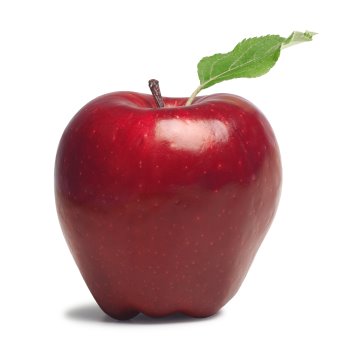
AgBC's: A is for Apples

For the first half of this year, we're going to try something fun: a look at the ABC's (or AgBC's as we'll call them) of various agricultural products, mainly fruits and vegetables. We'll look at the history of our featured products, share some simple experiments and maybe even some recipes to share with the kids in your life.
So first on the list: A is for apple.

Did you know that the apples we eat today come from apples that were grown more than 2 million years ago! Wow! When people first started eating apples, they just picked wild apples in the forest. These wild apples were small...only about the size of a strawberry....and they tasted bitter. Then about 10,000 years ago, during the Stone Age, people started planting and growing better apples.

Today's apples are related to those Stone age apples—only they are much bigger and sweeter. Apples can have skins that range in color from red to lemony-yellow to yellow-green. To me, apples taste yummy year-round, but the best, freshest ones can eb found in the fall just after they are picked. When buying apples, select firm, bright-colored apples with a fresh smell, andd they can be kept for a long time as long as they are stored in a cool place.


Now in this part of Ohio, Johnny Appleseed is pretty famous. John Chapman, as he was born, is responsible for introducing apple trees to large portions of Ohio, Indiana and Illinois. This American legend was famous because of his kindness, his generosity, and his conservation efforts and use of the apple in symbolism. He's a fascinating historical character and well worth a second look.

And now, for a little experiment on how to keep apples from browning after they are cut:

Have you ever notice how apples turn brown right after they are cut? Ever wondered how to stop that from happening?

Supplies needed: an apple, lemon juice, and lemon-lime soda (like Sprite or 7-Up)

What to do:
  1. Cut an apple into quarters.
  2. Eat one quarter, because they are delicious.
  3. Sprinkle one quarter with lemon juice, dip one in the soda, and leave one untreated.
  4. Lay them on a plate on the counter and see what happens. Which turns brown first?
  5. Have an extra apple? Repeat, only put the 3 quarters of one apple in the refrigerator. Compare what happens with those apples that are in the fridge to those that are on the counter.
Looking for a good read? Check out First Apple by Ching Young Russell, a story of a young Chinese girl's dream to taste an apple and buy one as a gift for her grandmother.

 This series is inspired by the book The ABC's of Fruits and Vegetables and Beyond.

Monday, December 20, 2010

Smart Stuff with Twig Walkingstick: Where do deer sleep during winter?

 Twig Walkingstick lives in and around the Wooster campus of the Ohio Agricultural Research and Development Center. His alter ego is Kurt Knebusch, one of our super-talented writers and editors on campus. Each month, look for Twig to answer a reader questions and some additional interesting facts below. After Twig's post, we will be providing some ideas and suggestions on how to incorporate the info in Twig's column into fun science learning for your students and children.

Q. Dear Twig: Where do deer sleep during winter?

A. In two kinds of places. The choice depends on whether it's daytime or nighttime. (I assume here a cold, snowy winter where the deer is. Are.)

At night, deer tend to sleep near coniferous ("kuh-NIFF-er-us") trees. (Coniferous trees you know might include pines, firs, spruces and hemlocks.) A usual spot is next to a trunk under thick, low, sheltering branches. The branches serve as a roof and a blanket. They keep out the wind, slow down how fast heat gets lost and help the deer save energy. A key for a deer to survive winter is to save energy.

During the day, deer sleep more in the open, away from deep, dark woods, a lot of times on a fill facing south or west. Why: To be in the sun. The sun's heat makes them warm. Or at least not as cold.

The technical term for both places is "bed sites." Deermay "bed" —lie down, sleep, or just hunker down and relax—at times throughout the day or night.

Long winter's nappilu,
Twig

P.S. Ohio's native deer is the white-tailed deer. Out west look for mule deer. Also, mules.


Notes from Twig: 
  • Mules, but not mule deer, like in Ohio too of course. And in many other places, such as "Hee Haw."
  • Subspecies of the mule deer (note: not a mule) are the Sitka deer (ditto) and black-tailed deer (ditto ditto). White tailed subspecies are the Coues (said "cooze." "cows" or "coos," depending on who says it) deer and Florida key deer.
  • Sources included "Winter Bed-site Selection by White-tailed Deer in Central Ontario," Journal of Wildlife Management, 1983.
  • Ohio State's experts on deer and wildlife management in general, but not mules, work in the School of Environment and Natural Resources, specifically in the Terrestrial Wildlife Ecology Laboratory.

--

Using this information for education:
Many students are preparing to celebrate the holiday season and dreaming of what they may find under the Christmas tree. Unlike the Christmas trees inside homes which have presents underneath them, nature's Christmas trees (pines, hemlocks and firs to name a few) are often a present to wildlife in and of themselves. 

Written by Colleen Monroe, A Wish to be a Christmas Tree is a fun holiday read that recounts the tale of a pine tree that has grown too large to ever be picked by a family as a Christmas tree. As he begins to cry, his woodland-creature-friends share how important he is to them...how he provides shelter from the storms with his branches, bedding for deer, and many other important benefits. Still sad, the tree is cheered when the animal s decorate him on their own and make him their own special Christmas tree.

This is a fun book to read during the holiday season, because it teaches the importance of friendship and helping others, but children can also learn about the important ecological functions of trees for wildlife in a fun way. And that includes providing cozy beds for deer in winter. Thanks, Twig!

Monday, December 13, 2010

Dreaming of a white Christmas?

Are you (and your little learners) dreaming of a white Christmas? How about if you take those dreams and turn them into predictions?

Here at OARDC we have an active weather station at our Wooster campus, and at 17 other sites across the Buckeye State. Current and past data for these stations is available free of charge online. So you can certainly check our weather at anytime, but that still leaves the question: will we have a white Christmas this year? Here's a fun way for older elementary to high school students to use historical weather data to create a map and color key to illustrate the likelihood of a white Christmas while learning about contour maps. The following lesson plan is based on the lesson available at educationworld.com
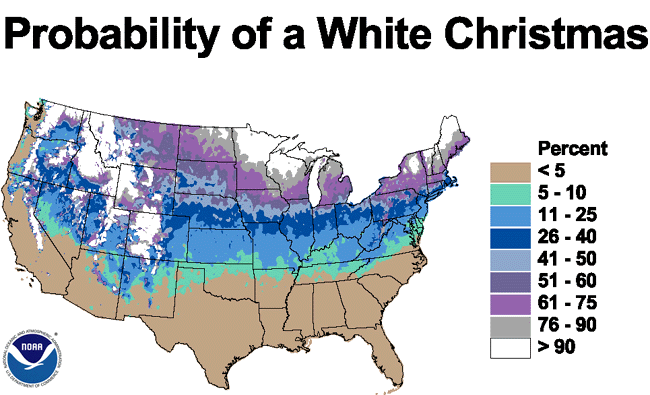
The National Climatic Data Center has calculated the probability of a White Christmas for the entire US (below). This map is based on the full range of data for each site rather than the 1971-2000 normal.

Here's what you'll need:

  • A color temperature map (many newspapers like USA Today publish such a map daily and are even available online)
  • Recording of the song I'm Dreaming of a White Christmas  (optional)
  • White Christmas Weather Data worksheet available free online
  • US outline map available free online
  • Atlas
  • Crayons or colored pencils
Will your students enjoy a white Christmas this year? Let's see what the historical weather data has to say about the likelihood for your part of the country...
  1. Start by showing students a color temperature map. Discuss how the map can be a quick guide to determine the current or high temperature for the day. Point out the color key as a tool to guide interpretation of the map.
  2. Ask students if they have any idea how this map, called a temperature contour map, is created. The color contour map is imply a pictorial representation of weather data. In the case of a contour map that shows the current temperatures around the United States, the data is a long list of temperatures in cities around the country. Students could create their own color contour map by gathering this data, plotting the temperatures in a wide variety of locations on an outline map and "connecting the dots" to approximate the approximate areas in which the temperatures are in the 20s, 30s, 40s, 50s, etc.
  3. For practice, you may want to provide students with data from a local paper on temperatures recorded the previous day or the high temperature estimate for the current day. Use the list to plot locations and temperatures. Demonstrate how students can create a color contour map to show those high temperatures. Then have students map the low temperatures of the day from the same source.
  4. Introduce and play the song I'm Dreaming of a White Christmas and pass out the White Christmas Weather Data worksheet. This worksheet includes figures representing the percent likelihood of snow being on the ground Christmas Day in 40 cities around the United States. This worksheet is intended for grades 5 and up. Younger students can focus on a state or region and map data for that smaller area. For example, the Illinois State Climatologist Office provides data for 13 sites across Illinois on the likelihood of snow on Christmas day. You may be able to find similar data for your state or region as well. Stormfax also provides a nice set of data for various states and regions.
  5. Have students plot the data on their map then create a color key to guide them as they color their contour maps. The color key will denote a different color for locations where the percent likelihood of snow on Christmas day is 0-20 percent, 21-40 percent, 41-60 percent, 61-80 percent and 81-100 percent. Be sure students understand that the maps they create are a simple approximation of the likelihood any area will have an inch of snow or more on the ground Christmas day. Geographic location can account for vast differences in snowfall in a small area. For example, their map will show that much of Arizona has little chance of snow cover on Christmas day, but a small area of the state, around the city of Flagstaff ( located in the mountains in the middle of the state) has a 57 percent chance of snow coverage on Christmas day!
  6. Have students share their maps with one another and with the class and discuss how accurately those maps depict the likelihood of snow cover. Check maps for accuracy in plotting city locations, but grant leeway in judging the final contour maps. Some variation needs to be allowed for where the controus might break between the plotted cities. Students should also have the opportunity to express in writing thelessons they learn (math and geography) from the activity.
Related Posts with Thumbnails